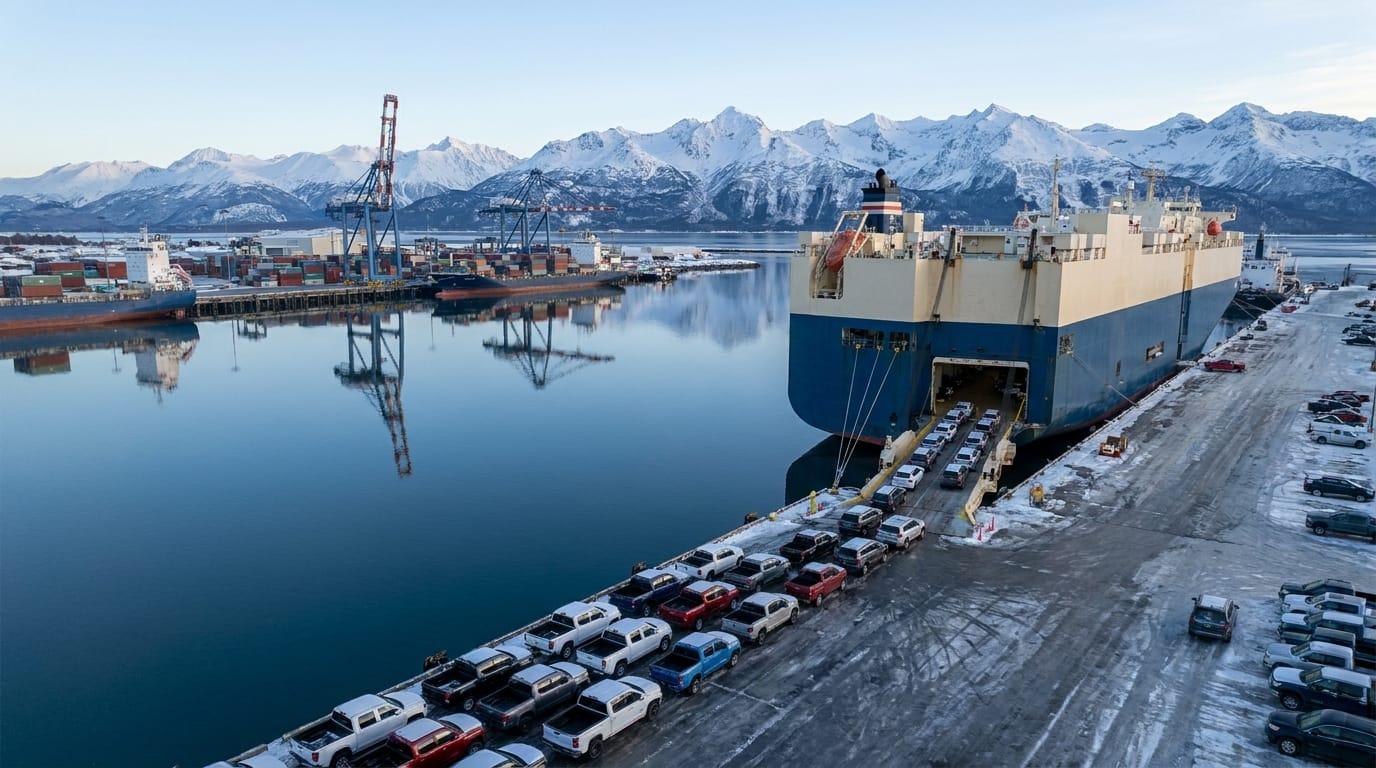
Alaska car shipping works differently from anywhere else in the country. Most vehicles bound for the state travel by truck to the Port of Tacoma in Washington, then ride a cargo vessel north across the Gulf of Alaska to the Port of Alaska in Anchorage. The voyage itself takes only a few days, but scheduled sailings, port receiving cutoffs and the truck legs on each end add time. Whether you need to ship a car to Alaska for a new job or bring one home to the Lower 48, the route you choose shapes both the timeline and the cost.
The alternative is overland. Carriers can drive the Alaska Highway, which starts at Dawson Creek, British Columbia, and winds roughly 1,390 miles through the Yukon to Delta Junction, Alaska. From Seattle to Anchorage that adds up to about 2,250 road miles, with a Canadian border crossing on the way. Few carriers run it, and mostly from late spring to early fall, when road conditions are reliable and daylight is long. Sahara Auto Transport can price both options so you can weigh a predictable ocean schedule against a direct truck.
Inside Alaska the road network is thin. Anchorage, the Mat-Su Valley, the Kenai Peninsula and Fairbanks connect by highway, but Juneau, Ketchikan, Sitka and most of Southeast Alaska do not, so vehicles reach them by barge or the state ferry system. Military moves to Joint Base Elmendorf-Richardson, Fort Wainwright and Eielson Air Force Base make up a large share of demand. At Sahara we explain each leg up front, including what the vessel line requires, so nothing about your Alaska shipment comes as a surprise.
Pickup and delivery
Where we ship in Alaska
Anchorage
Home of the Port of Alaska and the end point for most ocean shipments; cars are released at the terminal or delivered door to door across the Anchorage bowl.
Wasilla and Palmer
The Mat-Su Valley's growing suburbs sit roughly 40 to 45 miles north of Anchorage on the Glenn and Parks highways, an easy add-on to an Anchorage delivery.
Fairbanks
About 360 road miles north of Anchorage on the Parks Highway, with steady military traffic to Fort Wainwright and Eielson and winter lows that can reach 40 below.
Kenai and Soldotna
Reached on the Seward and Sterling highways, scenic two-lane roads where winter avalanche control near Turnagain Pass can cause short closures.
Juneau
The capital has no road connection to the rest of North America, so vehicles arrive by barge or Alaska Marine Highway ferry rather than by truck.
Ketchikan
Southeast Alaska's first port heading north from Washington, served by barge and ferry, with a compact road system on Revillagigedo Island.
Routes our carriers use
Main corridors in and out of Alaska
Alaska Highway
The overland route through British Columbia and the Yukon, entering Alaska at the Alcan border crossing near Tok; best traveled May through September.
Glenn Highway (AK-1)
Links Anchorage with Palmer and runs on to Glennallen, where the Tok Cut-Off continues toward the Alaska Highway.
Parks Highway (AK-3)
Runs from near Wasilla past Denali National Park to Fairbanks, the main road for interior deliveries.
Seward and Sterling Highways
Carry traffic from Anchorage along Turnagain Arm to Seward, Kenai, Soldotna and Homer.
Richardson Highway
Connects the port town of Valdez with Delta Junction and Fairbanks, crossing Thompson Pass, one of the snowiest places in the state.
Ports and logistics hubs
- Port of Tacoma, WA, the main departure point for Alaska-bound vehicles
- Port of Alaska in Anchorage
- Alaska Marine Highway ferry terminal in Bellingham, WA, for Southeast Alaska service
Transit times
How long shipping from Alaska takes
Seattle / Tacoma, WA (ocean)
about 1,450 nautical miles · 7 to 14 days
Custom quote
Seattle, WA (overland via Alaska Highway)
about 2,250 miles · 8 to 14 days
Est. $1,300 to $1,650
Fairbanks, AK
about 360 miles · 1 to 3 days
Est. $575 to $725
Los Angeles, CA (ocean plus truck)
ocean leg plus about 1,140 road miles · 14 to 24 days
Custom quote
Dallas, TX (ocean plus truck)
ocean leg plus about 2,100 road miles · 16 to 26 days
Custom quote
Transit starts once your vehicle is loaded. Prices are November 2026 estimates for a running sedan on an open carrier, not quotes. Ocean shipments to Alaska and Hawaii are priced individually.
Long summer days, deep winter cold
Summer is peak season. From May through August, military PCS orders, seasonal workers headed to fishing and tourism jobs, and new residents all compete for vessel space and for trucks running to Tacoma. Booking three to four weeks ahead gives you the best shot at your preferred sailing. This is also the only practical window for overland transport on the Alaska Highway, when long daylight and open roads let carriers make steady progress through the Yukon.
Ocean service runs year-round, but winter changes everything on land. Anchorage gets only about five and a half hours of daylight near the winter solstice and Fairbanks less than four, and temperatures in the interior regularly drop well below zero. Deliveries north of Anchorage can be slowed by ice fog, snow on the Parks Highway or closures at mountain passes. If your car arrives in winter, have it ready with the right antifreeze mix, a strong battery and, ideally, an engine block heater.
Local know-how
Tips for shipping a car in Alaska
- Vessel lines generally require the car to be running, with a quarter tank of fuel or less, no personal items inside and any aftermarket alarm disabled; we confirm the current rules before you book.
- If your vehicle is financed or leased, ask your lender for a letter authorizing shipment to or from Alaska, since ocean carriers commonly require one.
- Overland shipments cross into Canada and back, so have the title or registration ready and keep the vehicle free of anything that could complicate a border inspection.
- Like most states, Alaska expects new residents to register within a set window after establishing residency; check the Alaska Division of Motor Vehicles for the current rule.
- For Juneau, Sitka or Ketchikan, plan for a barge or ferry leg from Washington, because a truck cannot drive to those towns.
- Winter arrivals benefit from a plug-in block heater; many Alaska parking lots and driveways have outlets for exactly that reason.