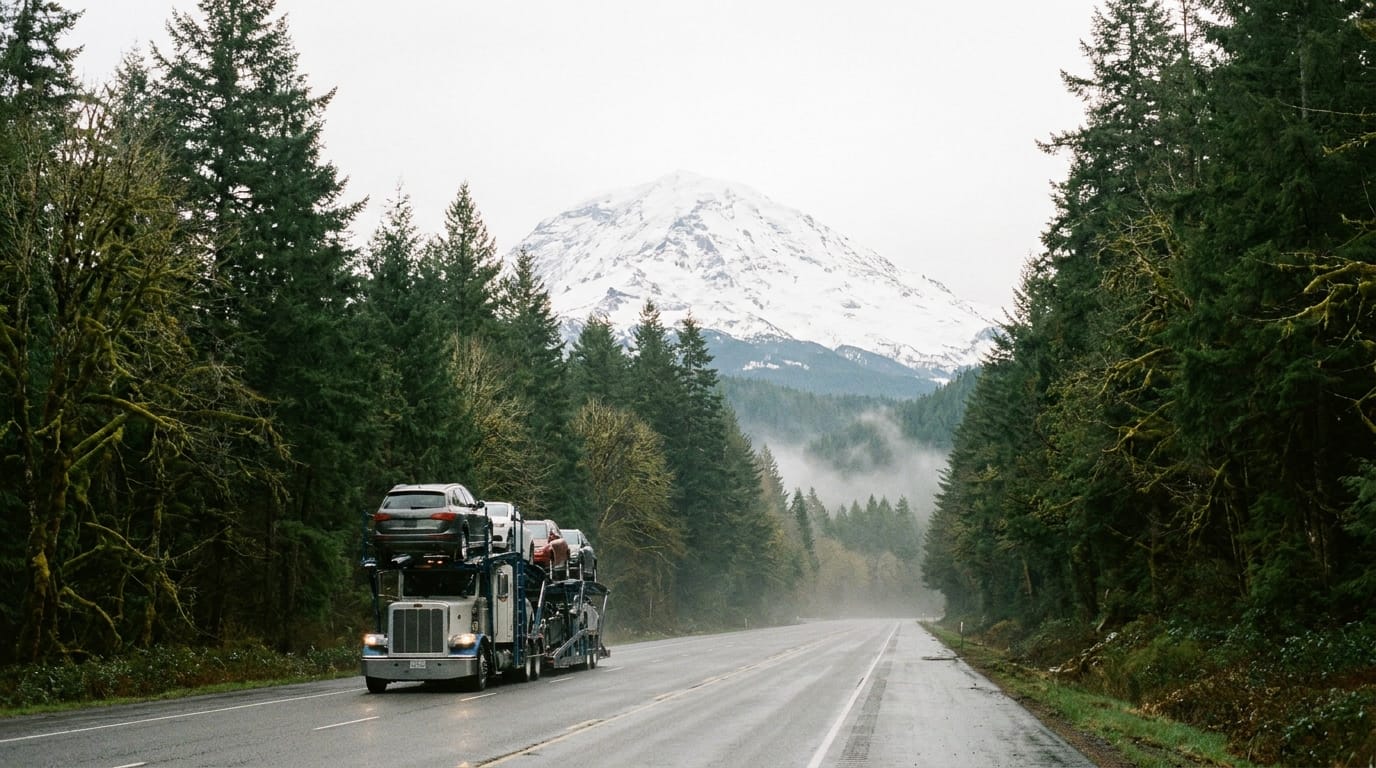
Washington car shipping is split by the Cascades. West of the mountains, Seattle, Tacoma, Everett, Bellevue and Olympia line up along I-5 in one long, busy corridor. East of them, Spokane, the Tri-Cities, Yakima and Wenatchee sit in drier, wide-open country. I-90 over Snoqualmie Pass is the main link between the two halves, and in winter that pass decides a lot about timing. Planning around it is the first thing we do.
The Puget Sound region also matters far beyond Washington. Tacoma is the main gateway for vehicles shipped to Alaska, with regular vessel service to Anchorage, so cars from across the Lower 48 often ride a truck to Tacoma before heading north by sea. Add tech relocations to the Eastside, military moves at Joint Base Lewis-McChord and Naval Base Kitsap, and steady California traffic on I-5, and the state stays busy year round.
Sahara Auto Transport arranges door to door shipping anywhere in Washington and coordinates the truck leg for Alaska shipments through Tacoma. We help you think through toll bridges, ferry-dependent addresses on the islands and pass conditions in winter. Whether you are moving from Seattle to Southern California or from Spokane to Texas, you get a realistic schedule and a carrier that runs the lane. For island or ferry-served addresses, we suggest a mainland meeting point before the carrier is even assigned.
Pickup and delivery
Where we ship in Washington
Seattle
Neighborhoods like Capitol Hill, Queen Anne and Ballard have steep hills and tight parking, so many pickups happen on wider arterials or at commercial lots near I-5.
Tacoma
Home to the Port of Tacoma and close to Joint Base Lewis-McChord, it is the staging point for Alaska vessel shipments and military moves.
Bellevue and the Eastside
Tech relocations to Bellevue, Redmond and Kirkland are constant, and carrier access usually runs through I-405 or I-90.
Spokane
Eastern Washington's largest city on I-90, about 280 miles from Seattle, with snowier winters and frequent moves to Idaho and Montana.
Vancouver
Across the Columbia River from Portland on I-5, so it shares carrier traffic with the Oregon market.
Tri-Cities
Kennewick, Pasco and Richland sit along I-82 and I-182 in the dry southeast, a common stop on runs to Boise and Salt Lake City.
City guides
Routes our carriers use
Main corridors in and out of Washington
I-5
The north to south spine from the Canadian border through Bellingham, Seattle, Tacoma and Olympia to Vancouver and Oregon, the main route to California.
I-90
Runs east from Seattle over Snoqualmie Pass to Ellensburg, Moses Lake and Spokane, continuing to Idaho, Montana and the Midwest.
I-82
Leaves I-90 at Ellensburg and heads through Yakima to the Tri-Cities and Oregon, connecting with I-84 toward Boise and Salt Lake City.
I-405
The Eastside bypass through Renton, Bellevue and Bothell, with express toll lanes that carriers usually avoid.
US-2
Crosses Stevens Pass between Everett and Wenatchee, an alternate when I-90 is closed but steep and snowy in its own right.
Ports and logistics hubs
- Port of Tacoma, where TOTE Maritime and Matson run regular vessel service to Anchorage for Alaska-bound vehicles
- Port of Seattle, which operates with Tacoma as the Northwest Seaport Alliance
- BNSF and Union Pacific intermodal yards in the Seattle and Tacoma area
Transit times
How long shipping from Washington takes
Los Angeles, CA
1,100 to 1,200 miles · 3 to 5 days
Est. $950 to $1,225
Phoenix, AZ
1,400 to 1,500 miles · 4 to 6 days
Est. $1,075 to $1,350
Dallas, TX
2,050 to 2,200 miles · 5 to 7 days
Est. $1,275 to $1,625
Orlando, FL
3,000 to 3,150 miles · 7 to 10 days
Est. $1,525 to $1,925
Anchorage, AK (vessel from Tacoma)
1,400 to 1,500 nautical miles · 7 to 14 days
Custom quote
Transit starts once your vehicle is loaded. Prices are November 2026 estimates for a running sedan on an open carrier, not quotes. Ocean shipments to Alaska and Hawaii are priced individually.
Snoqualmie Pass, rain and wildfire smoke
From roughly November through March, Snoqualmie Pass on I-90 can require traction tires or chains, and WSDOT sometimes closes the pass for avalanche control or crashes. Commercial trucks, including car carriers, face chain requirements earlier than passenger cars, so a truck may have to stop and chain up or wait for conditions to improve. Stevens Pass on US-2 and White Pass on US-12 have similar winter rules. East to west shipments in winter should have a spare day built in.
West of the Cascades, rain is the norm for much of the year but rarely stops shipping. Late summer brings a different issue: wildfire smoke and occasional fires in central and eastern Washington can close highways near Chelan, Yakima and the Columbia Basin. Alaska shipments have a season too, with vessel demand rising in spring and summer as people head north for work, so booking that leg early helps.
Local know-how
Tips for shipping a car in Washington
- Washington uses Good To Go for tolls on the SR 520 bridge, the Tacoma Narrows Bridge, the SR 99 tunnel and express lanes on I-405 and SR 167. Without a pass, bills arrive by mail at a higher rate, which matters once you are driving the car again.
- Most states expect registration within about 30 days of residency, and Washington follows that pattern. Check the Washington Department of Licensing for the current steps.
- Shipping to Alaska? Plan for the truck leg to Tacoma plus vessel transit and terminal time. Remove personal items, keep the fuel low and confirm the vessel line's current rules before drop-off.
- Island addresses on Bainbridge, Vashon or the San Juans usually mean meeting the carrier on the mainland side of the ferry.
- Seattle's steep, narrow streets can be tough for a large truck. A wide arterial or a store parking lot nearby is often the best handoff point.