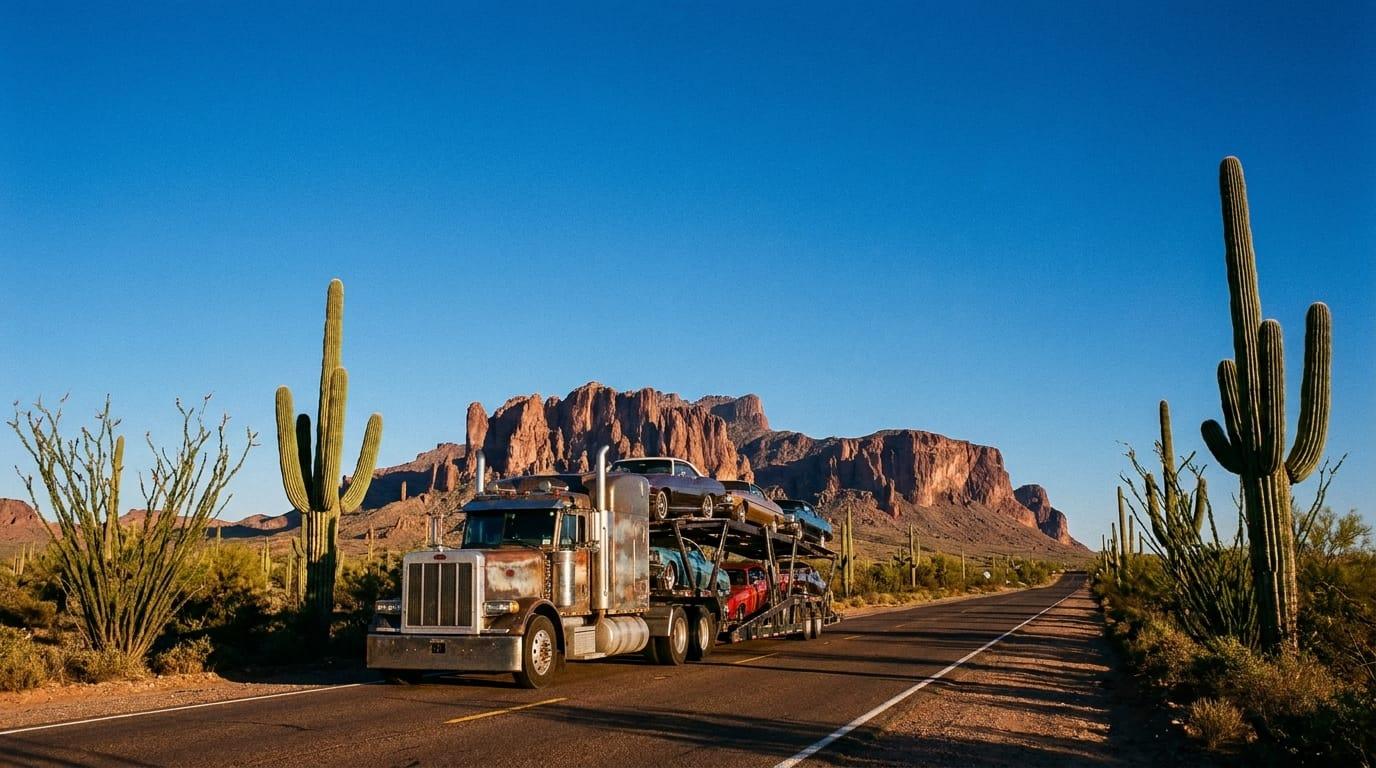
Arizona car shipping revolves around the Valley of the Sun. Phoenix, Mesa, Scottsdale, Chandler, Gilbert and Glendale hold well over half the state's population, and Interstate 10 delivers carriers straight into them from Southern California and Texas. Tucson sits about 115 miles southeast on the same highway, while I-17 climbs from Phoenix to Flagstaff and the cooler high country. Whether you want to ship a car to Arizona for retirement or move one out after a job transfer, the volume of trucks on I-10 keeps options open most of the year.
Few states feel the snowbird effect like Arizona. From October through April, retirees from the Midwest, the Pacific Northwest and western Canada settle into Mesa, Sun City, Surprise, Green Valley, Yuma and the RV parks around Quartzsite. Many fly in and have their cars shipped, then repeat the trip in reverse when the heat returns. Southbound demand is strongest in October and November and the northbound push runs from March into early May, so Sahara Auto Transport recommends booking a few weeks ahead on either side of the season.
Some parts of Arizona need extra planning. Tribal lands cover roughly a quarter of the state, the Navajo Nation and Hopi lands in the northeast have long gaps between towns, and some Sedona and Prescott neighborhoods sit on steep, narrow roads that big carriers avoid. For those addresses we pick a convenient meeting point. New vehicles built in Mexico also cross the border at Nogales, adding to the traffic on I-19. At Sahara we pair you with carriers who know these routes and the desert conditions that come with them.
Pickup and delivery
Where we ship in Arizona
Phoenix
The largest city spreads across a wide grid that carriers handle well, though gated HOA communities in north Phoenix may ask trucks to load outside the gate.
Scottsdale
Popular with collectors and seasonal residents, and enclosed transport is common here, especially around the big collector car auctions each January.
Mesa, Chandler and Gilbert
East Valley suburbs with dense master-planned neighborhoods and active-adult communities that fill with snowbirds every winter.
Tucson
About two hours from Phoenix on I-10, with demand from University of Arizona students and relocations tied to Davis-Monthan Air Force Base.
Flagstaff
Sits near 7,000 feet where I-17 meets I-40, so winter snow can briefly delay deliveries in a way Phoenix never sees.
Yuma
A winter haven on I-8 near the California line, with a large seasonal RV population and steady military moves tied to MCAS Yuma.
City guides
Routes our carriers use
Main corridors in and out of Arizona
I-10
The main artery from Los Angeles through Phoenix and Tucson to New Mexico and Texas; dust storms between Casa Grande and Picacho Peak can force short closures.
I-17
Climbs nearly 6,000 feet from Phoenix to Flagstaff, and weekend traffic plus long grades near Camp Verde slow loaded trucks.
I-40
Crosses northern Arizona from Kingman through Flagstaff and Holbrook into New Mexico, a favorite route for coast to coast carriers.
I-8
Links San Diego and Yuma with I-10 near Casa Grande, carrying snowbird traffic from Southern California.
I-19
Runs from Tucson to Nogales at the Mexico border, a key link for vehicles entering the US.
Ports and logistics hubs
- Ports of Los Angeles and Long Beach, the closest seaports at roughly 370 to 400 miles from Phoenix
- Nogales port of entry, where many Mexico-built new vehicles cross the border
- Union Pacific's Sunset Route through Tucson and BNSF's transcontinental line through Flagstaff
Transit times
How long shipping from Arizona takes
Los Angeles, CA
370 to 390 miles · 1 to 3 days
Est. $575 to $750
Dallas, TX
1,060 to 1,100 miles · 3 to 5 days
Est. $925 to $1,175
Seattle, WA
1,420 to 1,480 miles · 4 to 6 days
Est. $1,075 to $1,350
Minneapolis, MN
1,620 to 1,680 miles · 4 to 6 days
Est. $1,125 to $1,425
Chicago, IL
1,740 to 1,800 miles · 4 to 7 days
Est. $1,175 to $1,475
Transit starts once your vehicle is loaded. Prices are November 2026 estimates for a running sedan on an open carrier, not quotes. Ocean shipments to Alaska and Hawaii are priced individually.
Extreme heat, monsoon storms and snowbird months
Phoenix regularly tops 110 degrees in June, July and August. Heat is hard on tires, batteries and rubber seals, and it is hard on drivers loading cars on open asphalt, so carriers often prefer early morning pickups. If your car has a weak battery or aging tires, deal with it before the truck arrives. Interiors get very hot in transit, so remove anything that could melt or warp, like sunglasses, aerosol cans and electronics.
Monsoon season officially runs June 15 to September 30. Afternoon thunderstorms bring flash flooding to washes and low crossings, and towering dust storms, known locally as haboobs, can drop visibility to near zero on I-10 and I-8. Carriers pull over and wait them out, which can add a few hours. In winter the challenge shifts to the high country, where snow on I-17 and I-40 near Flagstaff occasionally closes roads. The snowbird calendar, October to April, sets the pricing rhythm for the rest of the year.
Local know-how
Tips for shipping a car in Arizona
- Arizona has essentially no toll roads, so a transponder is unnecessary here; carriers handle any tolls they meet in other states.
- Moving into the Phoenix or Tucson areas? Your vehicle may need an emissions test before registration, so check the Arizona MVD and ADEQ requirements.
- Arizona expects new residents to register promptly after establishing residency; confirm the timing with the Arizona MVD.
- Gated active-adult communities often limit trucks, so tell us the gate rules and we can plan a meeting spot at a nearby shopping center.
- In summer, park the car in a garage or shade before pickup and keep the windows fully closed so dust stays out during transport.
- Snowbirds heading north in spring should book by February, because the March and April window fills quickly.