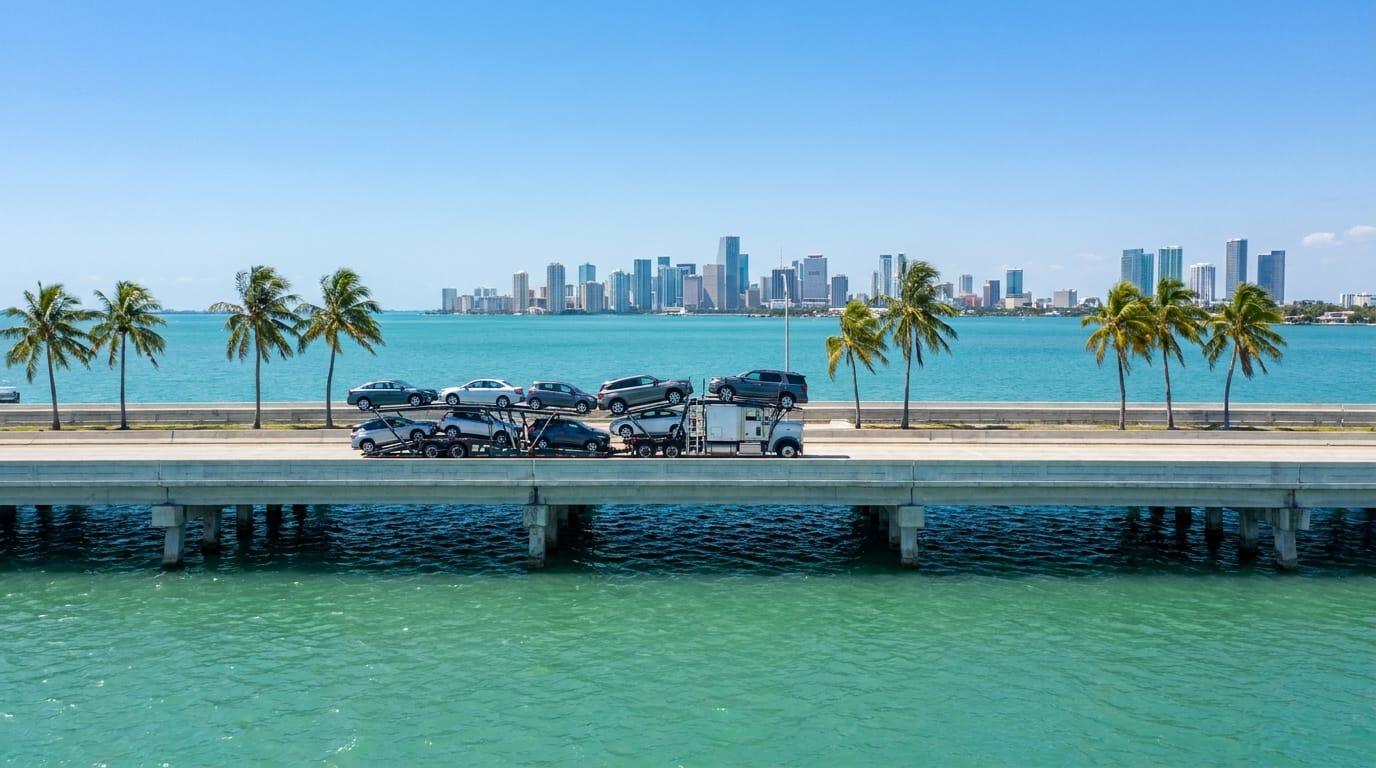
New York to Florida car shipping is one of the busiest lanes in the country, and for good reason. Every fall, thousands of New Yorkers close up apartments in Queens, houses on Long Island and lake cottages upstate, then head for Palm Beach, Sarasota or The Villages for the winter. Others are leaving for good, trading February slush and state income tax for a lanai. Whichever group you are in, shipping your car lets you take a quick flight south instead of spending two long days on I-95.
The pickup end of this lane shapes your experience more than the delivery end. A full-size car carrier cannot turn onto most brownstone blocks in Brooklyn or squeeze down a co-op service drive in Manhattan, so city pickups often happen on a wide avenue or in a nearby shopping center lot. In Nassau and Suffolk counties, Westchester and most of upstate, drivers can usually reach your driveway or curb. We sort this out with you before dispatch so nobody is circling the block in a 75-foot rig.
Florida is the easy part. Once trucks reach Daytona Beach, they either peel off onto I-4 for Orlando, Tampa and the Gulf side or stay on I-95 for the Space Coast, the Treasure Coast and South Florida. Sahara Auto Transport is based in Hollywood, Florida, so our team knows which Broward and Palm Beach condo towers want deliveries booked with the front desk and which 55+ communities ask carriers to meet at the gatehouse. One coordinator follows your car from pickup to unload.
Pricing
How much it costs to ship a car from New York to Florida
Estimated ranges for a typical trip of about 1,265 miles on this route, updated November 2026.
Sedan or coupe
- Open carrier
- $1,000 to $1,275
- Enclosed
- $1,550 to $1,975
SUV, crossover or minivan
- Open carrier
- $1,150 to $1,450
- Enclosed
- $1,775 to $2,275
Pickup or large SUV
- Open carrier
- $1,300 to $1,650
- Enclosed
- $2,000 to $2,550
- These are estimates, not quotes. Your exact price depends on the addresses, vehicle, condition, season and carrier availability.
- Non-running vehicles that need a winch usually add $150 to $250. Peak season and expedited pickup can raise the price.
How the I-95 run from New York to Florida works
Most carriers leave the New York metro over the George Washington Bridge or the Verrazzano to reach the New Jersey Turnpike, then follow I-95 through Delaware, Baltimore and the Washington area. South of Richmond the road opens up, and the long stretch through the Carolinas and Georgia is where drivers make their best time. Loads from Buffalo, Rochester and Syracuse often skip the crowded coast entirely, running south on I-81 or I-79 through Pennsylvania and the Virginias, then cutting toward Charlotte on I-77 and continuing to Florida on I-26 and I-95.
Traffic, not mileage, is the real variable. The stretch from the Bronx to the Delaware Memorial Bridge can eat half a day at rush hour, and the Capital Beltway and I-95 near Fredericksburg have their own slowdowns. That is why a run of roughly 1,100 to 1,300 miles still takes three to five days: drivers load several vehicles across the metro, follow federal hours-of-service limits and drop cars at more than one Florida stop on the way down.
City to city
Popular New York to Florida trips
New York City, NY → Miami, FL
1,280 miles · 3 to 5 days
Est. $1,000 to $1,275
Long Island, NY → West Palm Beach, FL
1,250 miles · 3 to 5 days
Est. $1,000 to $1,275
Westchester County, NY → Boca Raton, FL
1,240 miles · 3 to 5 days
Est. $1,000 to $1,250
Brooklyn, NY → Orlando, FL
1,080 miles · 3 to 4 days
Est. $925 to $1,175
Albany, NY → Tampa, FL
1,280 miles · 3 to 5 days
Est. $1,000 to $1,275
Buffalo, NY → Naples, FL
1,420 miles · 4 to 6 days
Est. $1,050 to $1,350
Transit times start at pickup. Prices are November 2026 estimates for a running sedan on an open carrier, not quotes.
When New York to Florida demand peaks
Southbound demand starts building in late September and runs hard through mid-December, with the heaviest weeks usually between mid-October and Thanksgiving. That is when snowbirds from Long Island, Westchester and the Hudson Valley head south, and carriers know they can fill every slot pointed at Florida. Booking two to three weeks ahead in that window gives you a much better shot at your preferred pickup date, and quotes tend to firm up as the holidays approach.
Late spring and summer are quieter going south, which can mean more flexible scheduling. The trade-off is that Atlantic hurricane season runs June through November, and a storm off the coast can push a Florida delivery back a day or two. Up north, early lake-effect snow around Buffalo and Syracuse in November and December can also delay an upstate pickup. We keep you posted whenever weather changes the plan.
Before you book
Tips for this route
- If you live in Manhattan, Brooklyn or Queens, pick a backup meeting spot such as a big-box store lot or a wide avenue near your building. It speeds up pickup and keeps the truck from blocking traffic.
- Take your E-ZPass tag off the windshield or seal it in its bag. Florida toll roads read E-ZPass, so a forgotten tag can be charged at gantries along the Turnpike while your car rides on the trailer.
- Heading to a gated community? Give us the gate code or put the driver's name on the visitor list ahead of time. Many 55+ communities in Palm Beach and Lee counties limit large trucks, so a clubhouse or nearby plaza handoff is common.
- If the move is permanent, Florida requires a VIN verification for vehicles titled out of state. Check the FLHSMV website for current residency and registration rules once you settle in.
- Keep personal items light and below the window line. Carriers generally allow a small amount, but belongings left in the car usually are not covered by the carrier's cargo insurance.