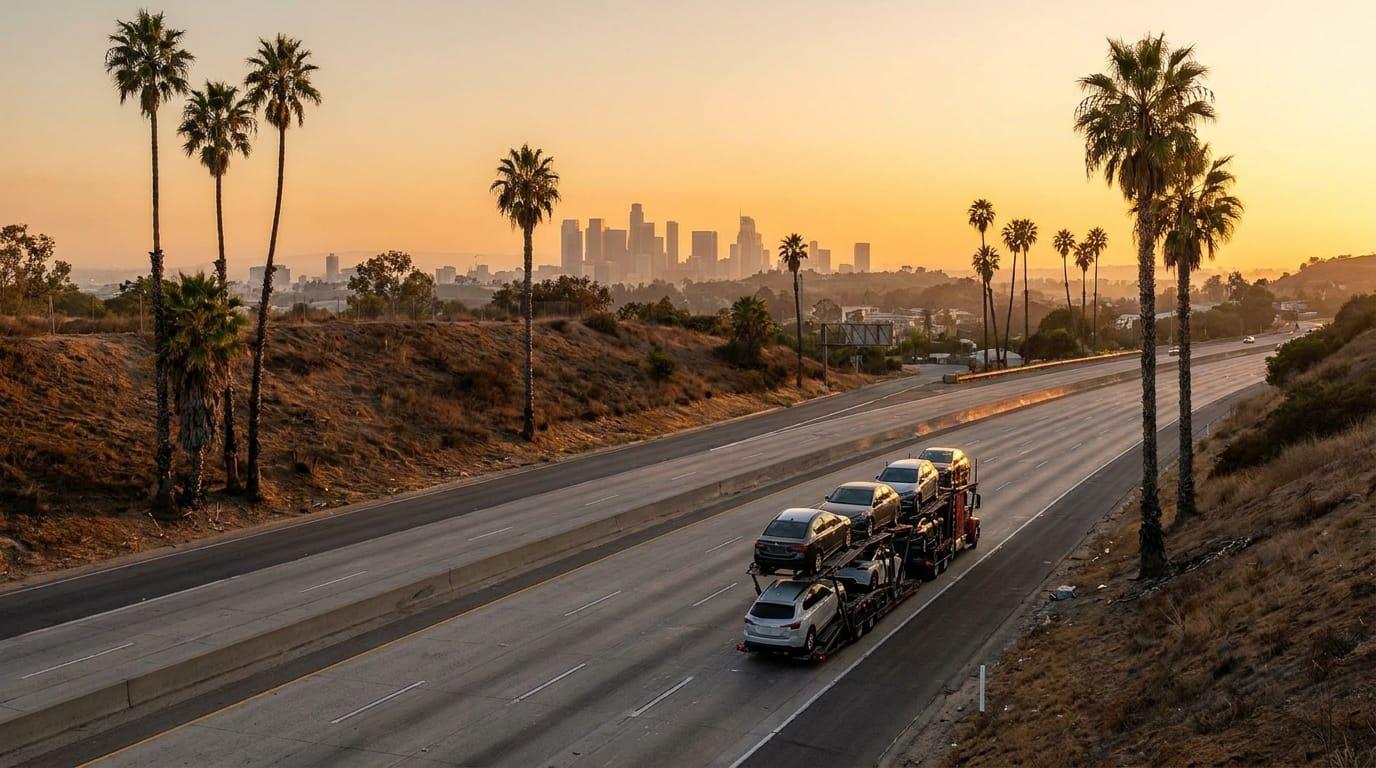
Texas to California car shipping serves a different crowd than the eastbound lane. Plenty of Texans head west for engineering roles in Silicon Valley, entertainment work in Los Angeles or biotech jobs in San Diego. Service members get orders from Fort Cavazos, Fort Bliss or Joint Base San Antonio to Camp Pendleton, Naval Base San Diego or Travis Air Force Base. Students leave Austin and College Station for UCLA, Stanford and the UC campuses. All of them need a car on the West Coast without burning three days on I-10.
Texas pickups are some of the easiest in the country. Wide arterial roads, big retail lots and sprawling suburbs around Houston, Dallas and San Antonio mean a full carrier can typically reach your home or a convenient meeting point. The tricky spots are older neighborhoods with low live oak canopies, like parts of Austin's Hyde Park or Houston's Heights, and new subdivisions where the HOA asks big trucks to stay out.
California delivery takes more care. Parking is tight in San Francisco and Los Angeles, many hillside streets cannot take a long carrier, and some cities enforce strict truck routes. Sahara Auto Transport plans your drop-off in advance, whether that is a driveway in Irvine or a meeting point near a BART station in Oakland. Because more cars flow east on this lane than west, westbound carriers are often looking for loads, which can make scheduling easier for you.
Pricing
How much it costs to ship a car from Texas to California
Estimated ranges for a typical trip of about 1,368 miles on this route, updated November 2026.
Sedan or coupe
- Open carrier
- $1,025 to $1,325
- Enclosed
- $1,600 to $2,050
SUV, crossover or minivan
- Open carrier
- $1,200 to $1,525
- Enclosed
- $1,850 to $2,350
Pickup or large SUV
- Open carrier
- $1,350 to $1,700
- Enclosed
- $2,075 to $2,650
- These are estimates, not quotes. Your exact price depends on the addresses, vehicle, condition, season and carrier availability.
- Non-running vehicles that need a winch usually add $150 to $250. Peak season and expedited pickup can raise the price.
Heading west on I-10 and I-40
Houston and San Antonio cars typically run west on I-10 the entire way, passing Kerrville, Fort Stockton, El Paso, Tucson and Phoenix before crossing the Colorado River at Blythe into California. From Dallas and Fort Worth, carriers either take I-20 west to meet I-10 in the Trans-Pecos or go northwest on US-287 to Amarillo and pick up I-40 across New Mexico and Arizona.
Bay Area deliveries usually follow I-40 to Barstow, then CA-58 to Bakersfield and I-5 or CA-99 north through the Central Valley. Southern California cars come in on I-10 through the San Gorgonio Pass or on I-15 down from Barstow into the Inland Empire. For San Diego, drivers turn off at Casa Grande, Arizona, and take I-8 through Yuma and over the mountains east of the city. Expect 3 to 6 days depending on the pair and the number of stops.
City to city
Popular Texas to California trips
Houston, TX → Los Angeles, CA
1,550 miles · 4 to 6 days
Est. $1,100 to $1,400
Dallas, TX → Los Angeles, CA
1,435 miles · 3 to 5 days
Est. $1,050 to $1,350
Killeen, TX → San Diego, CA
1,300 miles · 3 to 5 days
Est. $1,000 to $1,275
Austin, TX → San Francisco, CA
1,750 miles · 4 to 6 days
Est. $1,150 to $1,475
San Antonio, TX → San Diego, CA
1,280 miles · 3 to 5 days
Est. $1,000 to $1,275
El Paso, TX → Los Angeles, CA
800 miles · 2 to 3 days
Est. $800 to $1,025
Transit times start at pickup. Prices are November 2026 estimates for a running sedan on an open carrier, not quotes.
Seasonal patterns on the westbound lane
Westbound demand peaks in summer, when military PCS season, college move-ins and new job start dates line up from May through August. Even so, this direction usually has more open space than California to Texas, so pickups can often be scheduled on shorter notice. Late August is the crunch point, as students heading to UC campuses and military families with September report dates compete for the same trucks.
Winter shipping is usually smooth on I-10, which rarely sees snow. The I-40 route through Flagstaff is a different matter from December through March, when storms can close the interstate for hours and carriers reroute south. Arizona's monsoon season, roughly July through September, brings dust storms that can briefly shut down I-10 between Phoenix and Tucson, though they seldom delay a delivery by more than a day.
Before you book
Tips for this route
- Service members: tell us your base and report date when you book. We can plan pickup around your clearing schedule, and having your orders handy helps if dates shift.
- Budget time for a California smog check. Most gas vehicles registering in California for the first time need one, and the DMV expects new residents to register promptly, so check its site for the current deadline.
- If your car was sold new outside California, confirm it can be registered here before you ship. Used vehicles with 7,500 or more miles generally qualify, but newer cars can run into emissions certification rules.
- Bay Area bridges and Orange County's toll roads use FasTrak or pay-by-plate, not TxTag. Set up a FasTrak account soon after arrival so your Texas plates do not collect violation notices.
- For a San Francisco or Los Angeles hillside address, choose a flat, wide meeting spot nearby. It speeds up delivery and keeps the driver from getting stuck on a grade.